
Trojan and VMess
The two long-established protocols with the widest client support: Trojan dresses proxy traffic as ordinary HTTPS; VMess in PSM is WebSocket + TLS. They resist censorship less well than REALITY, so use them for older clients or as a spare.
| Trojan | VMess | |
|---|---|---|
| Transport | TCP + TLS | WebSocket + TLS |
| Cores | Xray, sing-box, mihomo | Xray, sing-box, mihomo |
| Certificate | Xray uses the domain's certificate; sing-box / mihomo accept a self-signed one | same |
| Shared port 443 | yes (--mount-443) | yes (--mount-443) |
| Common clients | nearly every client | nearly every client |
From the menu
| Core | Trojan | VMess |
|---|---|---|
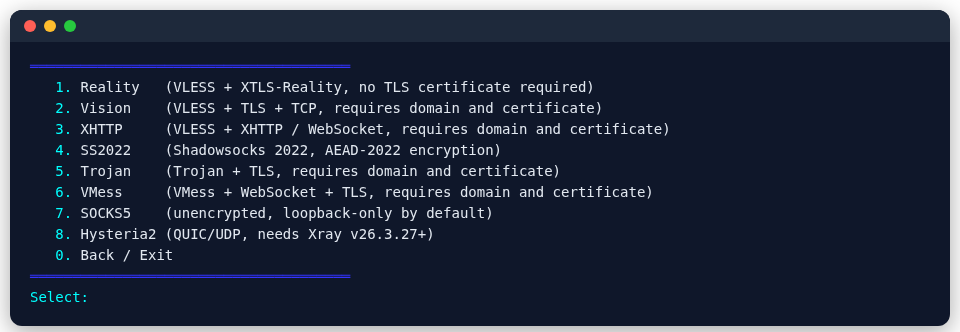
| Xray | main menu 4 → 4 → 5 | main menu 4 → 4 → 6 |
| sing-box | main menu 2 → 4 → 6 | main menu 2 → 4 → 7 |
| mihomo | main menu 3 → 4 → 6 | main menu 3 → 4 → 7 |
From the command line
Xray: as for Vision, point the domain at the VPS and issue its certificate in main menu 10 (SSL certificates), then:
bash
psm node add xray trojan --tag my-trojan --port 2096 --domain hk.example.com
psm node add xray vmess  --tag my-vmess  --port 2053 --domain hk.example.com
sing-box / mihomo: name the certificate files directly, adding --insecure 1 for a self-signed one:
bash
psm node add sing-box trojan --tag my-trojan --port 2096 \
  --sni hk.example.com \
--cert-path /etc/psm/certs/hk.crt --key-path /etc/psm/certs/hk.key| Option | Meaning |
|---|---|
--password | Trojan password; generated when left out |
--uuid, --path | VMess UUID and WebSocket path; generated when left out |
--mount-443 | put the node on shared port 443 |
--ech true | ECH for sing-box / mihomo Trojan |
Export for clients
bash
psm node export xray trojan my-trojan    # trojan:// link
psm node export xray vmess  my-vmess     # vmess:// link
